


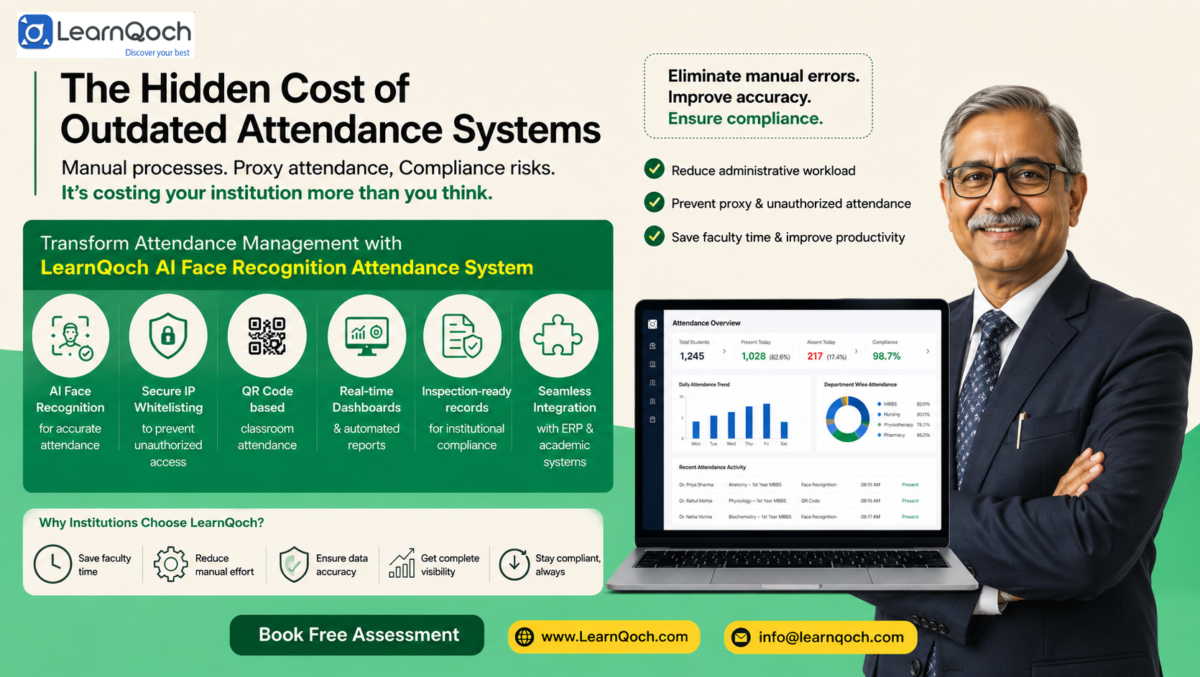
The Real Cost of Manual Attendance Management in Educational Institutions


Introduction
India’s education sector is rapidly embracing digital transformation. Schools, colleges, and universities are adopting Learning Management Systems (LMS), ERP platforms, digital admissions, online examinations, and other automation tools to improve academic and administrative efficiency.
However, attendance management is one essential academic process that often remains unchanged. Many institutions still rely on paper registers, spreadsheets, or disconnected systems to record attendance. Although this approach may seem inexpensive at first, manual attendance often results in hidden costs, including increased faculty workload, administrative effort, human errors, proxy attendance, delayed reporting, and compliance challenges.
As educational institutions continue to modernize their operations, it’s worth asking whether manual attendance is still the most effective approach. After all, the real question is no longer whether institutions can continue using manual attendance, but rather how much it is costing them every day in terms of time, productivity, operational efficiency, and overall academic performance.
This blog explores the real costs of manual attendance systems and explains why institutions are rapidly adopting intelligent digital attendance platforms like LearnQoch AI Face Recognition Attendance System to improve operational excellence and institutional compliance.
A Monday Morning That Every College Can Relate To
Location: Department Office
Dr. Sharma (HOD):
“Good morning, Prof. Mehta. Can you share the attendance report for Semester V? We have a parent meeting this afternoon, and I need the latest attendance figures.”
Prof. Mehta (Class Teacher):
“Certainly, sir. According to my attendance register, Rahul has attended 38 out of 45 lectures. He’s one of the most regular students in the class.”
(Just then, Prof. Anjali, another subject teacher for the same class, walks into the office.)
Prof. Anjali:
“That’s interesting. According to my attendance report, Seema has the highest attendance in the class—not Rahul.”
Prof. Mehta:
“That can’t be right. I’m the class teacher. I take the first lecture every morning and even verify attendance during the last lecture of the day. Rahul has been consistently present.”
Prof. Anjali:
“Let’s compare our records.”
(Both faculty members open their attendance registers and reports.)
Prof. Anjali:
“See here. In my report, Seema has 95% attendance, while Rahul has 68%.”
Prof. Mehta:
“But my records show Rahul at 95% and Seema at 68%. How is that possible? Are students attending some lectures and skipping others, or are our records not matching?”
(They continue checking more students.)
Prof. Mehta:
“Look at this—it’s not just Rahul and Seema. Several students have different attendance percentages in our reports.”
Dr. Sharma (HOD):
“This is exactly the issue we’ve been facing. Every faculty member has a different attendance count, while the department spreadsheet shows something else, and the ERP report displays yet another set of numbers. Which report should we trust for parent meetings, examination eligibility, or accreditation?”
The room falls silent.
Because everyone realizes the problem isn’t the students—it’s the manual attendance process.
If this conversation sounds familiar, you’re not alone. In fact, thousands of schools and colleges still rely on paper registers, spreadsheets, and disconnected systems. As a result, they often face inconsistent attendance records, faculty confusion, and administrative delays.
This is where LearnQoch AI Face Recognition Attendance System becomes the single source of truth for your institution.”
Why Manual Attendance No Longer Fits Modern Education?
Traditional attendance systems were designed for classrooms with limited students and minimal reporting requirements.
Today’s educational institutions must:
- Track attendance across multiple campuses
- Maintain audit-ready records
- Generate real-time reports
- Support NAAC and accreditation processes
- Meet NEP 2020 digital transformation goals
- Integrate attendance with ERP and academic systems
Manual attendance simply wasn’t built for these expectations.
What is Hidden Costs of Manual Attendance Systems?
1. Faculty Time Lost Every Day
One of the biggest costs isn’t money—it’s faculty time.
Every lecture begins with:
- Calling student names
- Waiting for responses
- Verifying doubtful attendance
- Updating registers
- Entering records into software later
For institutions conducting hundreds of lectures daily, these few minutes accumulate into hundreds of lost teaching hours every semester.
Instead of focusing on learning outcomes, faculty spend valuable time on administrative work.
LearnQoch Solution
AI Face Recognition and QR Code attendance mark attendance within seconds, allowing faculty to begin teaching immediately.
2. Human Errors Reduce Data Accuracy
Manual systems are highly susceptible to:
- Wrong entries
- Missed attendance
- Duplicate records
- Incorrect roll numbers
- Miscalculated attendance percentages
These errors often result in student complaints and administrative corrections.
Digital attendance platforms automatically record attendance, ensuring higher accuracy and eliminating repetitive manual corrections.
3. Proxy Attendance Becomes Difficult to Control
One of the oldest challenges in educational institutions is proxy attendance.
Students may answer on behalf of absent classmates or manipulate attendance records.
This compromises institutional discipline and creates inaccurate academic records.
LearnQoch Prevents Proxy Attendance Through
- AI Face Recognition
- QR Code Verification
- Secure IP Whitelisting
- User Authentication
Only authorized attendance is recorded.
4. Administrative Workload Continues to Grow
Attendance isn’t just recorded once.
Administrative teams must:
- Verify records
- Prepare reports
- Respond to student requests
- Share attendance summaries
- Maintain archives
- Generate department-wise reports
Manual processes require continuous intervention.
Instead of relying on manual processes, digital attendance automates everyday workflows, making attendance management faster and more efficient.
5. Compliance Risks Increase
Educational institutions undergo multiple audits and accreditation processes.
They are preparing for:
- NAAC
- Autonomous status
- Internal audits
- University inspections
attendance records must be complete, accurate, and easily accessible.
Paper registers are difficult to organize, verify, and retrieve.
LearnQoch maintains inspection-ready digital records that simplify compliance and reporting.
6. No Real-Time Visibility
With manual attendance, administrators often discover attendance issues only after weeks or months.
This delay affects:
- Student counselling
- Parent communication
- Attendance interventions
- Academic planning
Digital dashboards provide instant visibility into attendance trends.
Institution leaders can monitor:
- Overall attendance
- Department performance
- Daily absenteeism
- Compliance percentage
without waiting for manual reports.
The Financial Cost Institutions Often Ignore
Many institutions believe manual attendance is a low-cost solution because paper registers are inexpensive. However, in reality, the true cost goes far beyond paper. Instead, it lies in the time, effort, and human errors involved in managing attendance, which, in turn, reduce operational efficiency and increase the administrative burden.
- Faculty working hours
- Administrative manpower
- Printing registers
- Record storage
- Error correction
- Report preparation
- Compliance documentation
Impact on Student Success
Attendance is directly linked to academic performance.
Manual tracking delays the identification of students with poor attendance.
Result:
- Academic interventions happen late
- Student engagement decreases
- Dropout risks increase
- Internal assessment eligibility becomes difficult to monitor
Digital attendance systems provide timely alerts, enabling institutions to support students before attendance becomes a serious issue.
Why NEP 2020 Encourages Digital Attendance?
NEP 2020 promotes technology-enabled governance and digital transformation in education.
Digital attendance contributes by enabling:
- Transparent academic administration
- Data-driven decision-making
- Better institutional governance
- Improved student monitoring
- Digital documentation
- Seamless integration with ERP systems
Institutions embracing digital attendance are better aligned with the objectives of modern education and the vision of Viksit Bharat.
Features That Help Eliminate Manual Attendance Costs
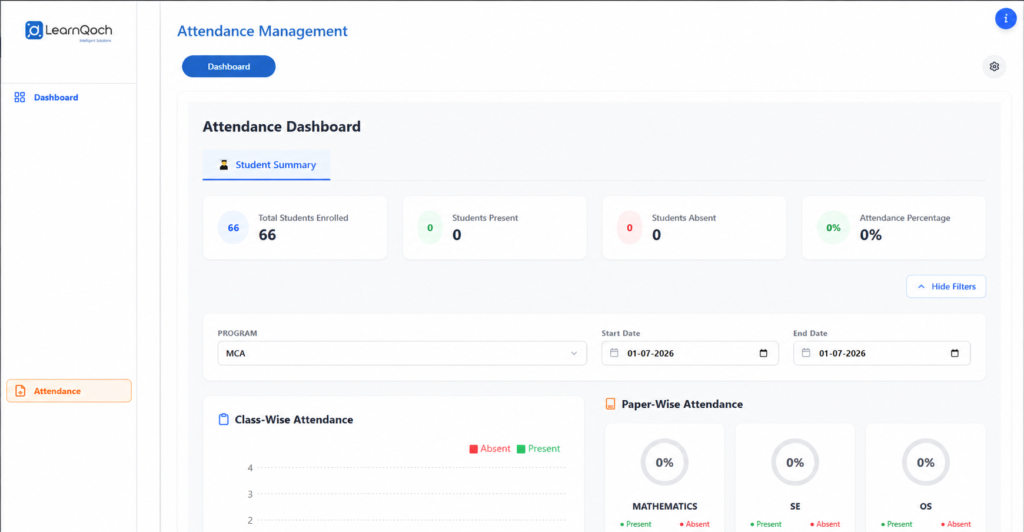
Drawing from the LearnQoch Digital Attendance Platform, institutions can modernize attendance management with intelligent automation.
AI Face Recognition
Quickly and accurately identifies students, thereby making attendance effortless while eliminating manual roll calls and preventing proxy attendance.
Secure IP Whitelisting
Restricts attendance submissions to authorized campus networks, ensuring secure and authentic attendance records.
QR Code-Based Attendance
Enables fast, classroom-specific attendance marking with minimal faculty intervention.
Real-Time Dashboards
Provides instant insights into attendance trends, departmental performance, and compliance metrics.
Inspection-Ready Records
Automatically maintains organized digital records that simplify audits, accreditation visits, and institutional inspections.
Seamless ERP Integration
Connects attendance data with ERP, academic management systems, and student information systems, eliminating duplicate data entry.
Why Institutions Choose LearnQoch?
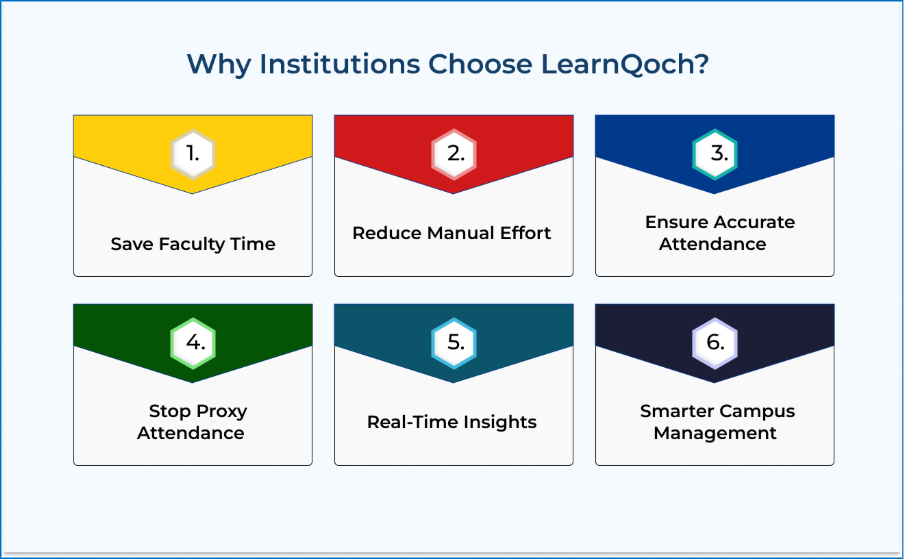
LearnQoch’s AI-powered attendance platform is designed to solve the operational challenges faced by modern educational institutions.
Key benefits include:
1. Save Faculty Time
With attendance recorded automatically in seconds, faculty can focus more on teaching and student engagement instead of spending valuable time maintaining manual registers. As a result, classroom productivity and overall efficiency improve significantly.
2. Improve Attendance Accuracy
Leverage AI-powered verification to eliminate manual errors and maintain accurate, reliable attendance records every day.
3. Prevent Proxy Attendance
Use AI Face Recognition, QR Code verification, and secure authentication to ensure only genuine student attendance is recorded.
4. Gain Real-Time Visibility
Access live dashboards and instant reports to monitor attendance trends, identify absenteeism, and make informed decisions quickly.
5. Maintain Audit-Ready Records
Keep secure, digital attendance records that simplify audits, accreditation processes, and institutional compliance with NEP 2020 requirements.
Conclusion
The hidden costs of manual attendance extend far beyond paper registers. Lost faculty time, administrative burden, inaccurate records, compliance risks, and delayed interventions collectively impact institutional efficiency, student engagement, and academic outcomes.
As educational institutions align with the goals of NEP 2020 and contribute to the vision of Viksit Bharat 2047, adopting a digital attendance system is no longer just a technological upgrade—it’s a strategic investment in smarter campus operations, transparency, and institutional excellence.
LearnQoch Attendance Management System is designed to help schools, colleges, and universities overcome these challenges with a secure, intelligent, and scalable attendance platform. Instead of relying on manual registers or disconnected systems, institutions can now automate the entire attendance process. With features such as Face Recognition, Secure IP Whitelisting, QR Code-based Attendance, Real-Time Dashboards, Inspection-Ready Records, and Seamless ERP Integration, they can not only simplify daily attendance management but also improve accuracy, transparency, and operational efficiency.
As a result, institutions can improve attendance accuracy, prevent proxy attendance, reduce administrative workload, simplify record management, and stay prepared for accreditation and regulatory requirements with greater confidence.
Our AI powered Academic Platform
LQ goes further by providing an integrated platform that covers all aspects of institutional growth:

Institutional Digital Ecosystem: Categories & Modules
| Category | Modules Available | What It Does (Core Capability) |
|---|---|---|
| A. Core Academic & Learning | LMS, OBE, Academic Calendar, Class Module | Digitizes modern teaching, manages timetables, and maps specific student skill metrics. |
| B. Examination & Evaluation | Exam Management Module | Automates the complete exam lifecycle: planning, ATKT processing, and automated question paper generation. |
| C. Campus Administration | ERP, Task Management, Committee, Document, Certificate Management | Automates student data, workflow management, corporate governance, and instant certificate issuance. |
| D. Finance & Fees | Receivable (Fees), Advanced Fees, Excess Fees | Tracks fee categories, handles online tuition collections, and records advanced or excess payment adjustments. |
| E. Library & Resource | Library Module | Streamlines textbook registration, student tracking, renewals, and live book availability. |
| F. Placement & Careers | Placement Module, Skill Development | Connects TPOs with job openings, student registration, and future-ready job training. |
| G. Digital Marketing & Institution Growth | LQ Growth+ | A unified dashboard to manage social media, WhatsApp, Email, SMS campaigns, and website health metrics. |
| H. Accreditation & Quality | NAAC, NBA & NIRF Compliance | Drastically reduces institutional audit workload with one-click compliance reporting tools. |
| I. Digital Presence | Website & Digital Marketing Solutions | Build custom web portals and automated communication funnels to attract prospective students. |
Don’t Just Take Our Word for It—Try LearnQoch Yourself!
We invite you to experience the transformative impact of our AI powered Digitize Platform with a 14-Day Free Trial.
During this period, our team will implement the software for your institution, allowing you to explore its features firsthand and see the difference it can make in academic management.
👉 Are you ready to lead your institution into the future of campus management?
📞 Contact us at +91 84519 01079
📧 Email:sales@learnqoch.com
Explore What LearnQoch Offers:
Visit www.learnqoch.com for Full Details